How AI is Changing Resume Screening in 2026
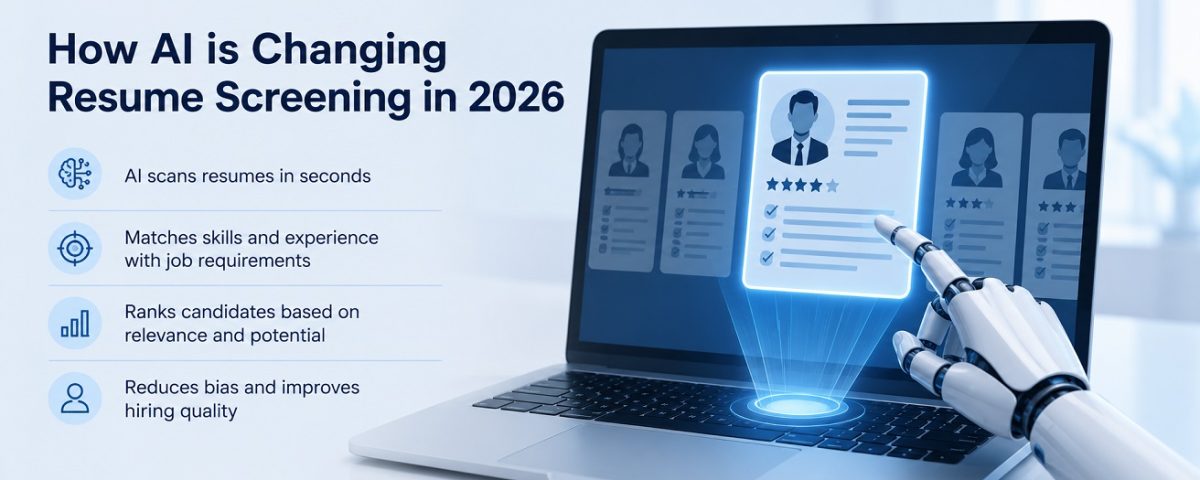
The hiring process has changed dramatically over the last few years, and in 2026, Artificial Intelligence (AI) is now at the center of resume screening. Companies no longer rely only on recruiters manually reviewing hundreds of applications. Instead, AI-powered Applicant Tracking Systems (ATS) are filtering, ranking, and analyzing resumes within seconds.
For job seekers, this shift creates both opportunities and challenges. A well-optimized resume can quickly reach hiring managers, while a poorly structured one may never be seen by a human recruiter.
In today’s competitive job market, understanding how AI screening works is no longer optional — it is essential.
The Rise of AI-Powered Hiring
Most large companies now use AI-driven recruitment platforms to manage the hiring process. Modern ATS systems do far more than simple keyword matching. They use technologies like Natural Language Processing (NLP), semantic analysis, predictive scoring, and machine learning to evaluate candidates.
Earlier ATS systems only searched for exact keywords. For example, if a job description mentioned “Project Management” and your resume used “Team Leadership,” the system might not recognize the similarity.
In 2026, AI systems are much smarter. They understand context, achievements, skills, and even career progression. This means recruiters are no longer just searching for keywords — they are searching for evidence of capability.
How AI Resume Screening Works
When a candidate submits a resume, AI screening software performs several actions almost instantly:
1. Resume Parsing: The system extracts information such as:
Name and contact details
Work experience
Skills
Certifications
Education
Achievements
Poor formatting, tables, graphics, or unusual fonts can confuse ATS software and reduce resume accuracy.
2. Skill Matching: AI compares the resume against the job description to identify relevant skills, qualifications, and experience.
Modern ATS platforms use semantic matching instead of simple keyword matching. For example:
“Managed cross-functional teams”
“Led collaborative projects”
Both may be interpreted as leadership or project management skills.
3. Candidate Scoring: AI systems assign scores based on:
Relevance of skills
Years of experience
Industry alignment
Certifications
Quantified achievements
Career consistency
Candidates with stronger matches are ranked higher for recruiter review.
4. Predictive Analysis: Some advanced systems now predict whether a candidate is likely to succeed in the role based on historical hiring data and performance trends.
Why Traditional Resumes No Longer Work
In 2026, generic resumes are becoming ineffective.
Recruiters receive thousands of applications for a single role, and AI helps them reduce the volume quickly. Studies suggest many resumes are rejected before a recruiter ever sees them.
Common mistakes that hurt resumes today include:
Keyword stuffing
Long paragraphs
Generic career summaries
Fancy designs
Missing measurable achievements
Using outdated terminology
Modern AI systems prefer clarity, relevance, and evidence-based achievements.
For example:
Instead of:
“Responsible for sales growth”
Use:
“Increased quarterly sales revenue by 32% through digital marketing campaigns.”
Specific achievements carry much more value in AI screening.
AI vs Human Recruiters
One interesting trend in 2026 is that candidates are also using AI tools to write resumes. However, recruiters are becoming increasingly aware of overly generic AI-generated content.
Research shows many hiring managers reject resumes that sound robotic or lack authenticity.
At the same time, AI screening systems may unintentionally favor resumes optimized by similar AI models. Some recent studies even suggest AI systems can show “self-preference bias” toward resumes generated using familiar language patterns.
This creates a strange situation:
Companies use AI to screen resumes
Candidates use AI to create resumes
AI evaluates AI-written content
As a result, authenticity and personalization are becoming more important than ever.
The Skills AI Looks for in 2026
AI-driven hiring systems now prioritize practical and measurable skills over vague descriptions.
High-performing resumes usually include:
Quantified achievements
Technical skills with versions/tools
Industry-specific keywords
Business impact
Leadership examples
Certifications
Problem-solving abilities
Recruiters also value adaptability, digital literacy, and AI-related skills because many industries are rapidly adopting automation.
The Shift Beyond Resumes
Another major change in 2026 is that companies are beginning to move beyond resumes entirely.
Many employers now evaluate candidates using:
Online assessments
Portfolio reviews
Live projects
Video interviews
Skill-based challenges
AI-analyzed interview responses
This trend focuses more on practical capability than traditional credentials.
A resume is still important, but it is increasingly becoming the first step rather than the final deciding factor.
How Job Seekers Can Adapt
To succeed in AI-driven hiring, candidates need to create resumes that work for both machines and humans.
Here are some effective strategies:
Use ATS-Friendly Formatting
Use simple layouts
Avoid graphics and tables
Use standard headings
Save in Word or PDF format
Tailor Every Resume
Customize your resume for each role using relevant keywords from the job description.
Focus on Achievements
Use measurable results and business impact instead of responsibilities alone.
Keep Language Natural
Avoid robotic or overly generic AI-generated phrases.
Add Relevant Skills
Include current tools, certifications, and technologies related to your field.
Optimize LinkedIn Profiles
Many AI recruitment systems now analyze LinkedIn profiles alongside resumes.
The Future of Resume Screening
AI hiring technology will continue evolving rapidly. Future systems may analyze:
Communication style
Career growth patterns
Soft skills
Portfolio quality
Online professional presence
At the same time, concerns around bias, fairness, and transparency are growing. Researchers and companies are actively discussing ethical AI hiring practices to ensure qualified candidates are not unfairly rejected.
Read more: Resume Writing Services for Healthcare Professionals
Conclusion
AI has completely transformed resume screening in 2026. Modern hiring systems are faster, smarter, and more data-driven than ever before. While this technology helps companies manage high application volumes efficiently, it also means job seekers must adapt to a new hiring reality.
Today’s successful resume is no longer just a document — it is a strategic marketing tool designed for both AI systems and human recruiters.
Candidates who combine ATS optimization with authentic storytelling, measurable achievements, and relevant skills will have the best chance of standing out in the evolving world of AI-driven recruitment.